
Blog Post #1
Poor mental health is something numerous Canadians experience at some point during their life and many times a decline in an individual’s psychological health can be attributed to their occupations and places of work. Many employees experience stress from excessive workloads, depression from time away from their family, or a sense of fear and anxiety from workplace harassment. Due to instances like these, every week 500,000 Canadian employees are unable to work, and this massive loss of working hours has resulted in an annual economic cost of $50 billion and $6.3 billion lost in productivity (Weikle, 2019).
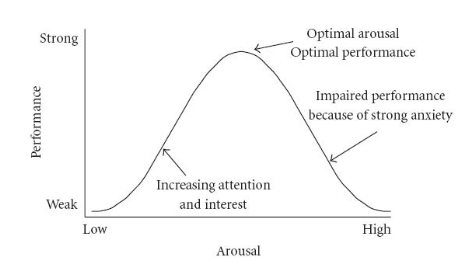
This graph above demonstrates that although stress can induce optimal performance from an increase in attention and interest, too much stress can impair a worker’s performance to the level of low arousal. In order for workers to be motivated to complete their duties with success, it is essential to place pressure on the workers. With that being said, if workers experience little reward, abuse, unattainable expectations, poor work environment, or have little opportunity for growth, the employees are more likely to lack motivation and experience lower mental wellbeing causing reduced productivity (Government of Canada, 2016).
Thankfully due to the decreasing stigma surrounding mental health, workplaces have become more aware of the hindering effects poor mental health has on employees and how it effects the company’s productivity and growth. Based off a study conducted by Deloitte, they discovered that for every dollar invested in mental health in the workplace, there is a return of $1.62 and a return of $2.18 if mental health programs have been implemented for three years or longer (Weikle, 2019).
To encourage positive mental health, employers, management and organization teams need to focus their time to eliminate stress in the workplace and encourage their employees to participate in physical activity, healthy eating and mediation. To optimize employee’s productivity and mental health, companies should concentrate their efforts on preventing negative mental wellbeing rather than dealing with the treatment. Additionally, allowing workers to take days off and enable a smooth and gradual transition back to work will likely decrease burn out and maintain employee happiness and morale (Weikle, 2019).
Deloitte isn’t the only company that has taken steps to improve their mental health program as one third of Canadian employers have mental health strategies (Weikle, 2019). Starbucks Canada for example has pledged to give $5000 a year to its employees to cover therapy costs and many companies are following in Starbucks footsteps with improving their mental health initiatives (Anderssen, 2016). Millennials are a generation that advocate for mental health and if a position they are interested in lacks mental health support, they are likely to turn down the job leaving the company without their talent and skills (Weikle, 2019).
I believe that investing in mental health is not only important for the employees, but for the benefit of the entire company as well. With happy and healthy employees comes better opportunity for economic growth and prosperity. Employers must remember that their employees are people too and must take the appropriate steps to ensure their mental health needs are noticed.
Please let me know your thoughts and opinions on my post!
References
Anderssen, E. (2018, May 17). Why Starbucks Canada’s investment in mental health therapy matters. Retrieved February 8, 2020, from https://www.theglobeandmail.com/life/health-and-fitness/health/why-starbucks-canadas-investment-in-mental-health-therapy-matters/article32252755/
Government of Canada. (2016, July 14). Psychological Health in the Workplace. Retrieved February 8, 2020, from https://www.canada.ca/en/employment-social-development/services/health-safety/reports/psychological-health.html
Weikle, B. (2019, November 7). Workplace mental health programs deliver healthier bottom lines | CBC News. Retrieved February 8, 2020, from https://www.cbc.ca/news/business/workplace-mental-health-programs-deliver-good-roi-1.5346872?__vfz=medium=sharebar
Feature image sourced from…
Muneeb, A. (2018, October 22). Mental Health in the Workplace. Retrieved February 8, 2020, from https://thriveglobal.com/stories/mental-health-in-the-workplace/
 Emma Tigert's Blog
Hi Emma,
Mental health is an important topic and a very relevant topic for today’s employees and employers! The study you mention in your post conducted at Deloitte which discovered the productivity and economic benefits that investing in mental health has, more specifically the return of $2.18 of $1.62 invested. This is an important note for future companies because they can see how the mental health of their employees directly affects their productivity.
Another benefit of more investment in mental health is the effectiveness of the health care industry when nurses, doctors, and other health professionals have access to proper coping methods to deal with mental health issues.
I found one study that demonstrates associations in nurses between “ways of coping, job demands, levels of control, social support, extrinsic effort, over-commitment, rewards, and anxiety and depression”. With that being said, the study showed significantly higher positive outcomes when anxiety and depression were confronted with coping behaviors rather than the use of demand-control-support or effort-reward.
I think this is an interesting addition to your original post because this study looked at the different approaches to mental health.
Great post!
Rachel
Citation:
Mark, G., & Smith, A. P. (2011). Occupational stress, job characteristics, coping, and the mental health of nurses. British Journal of Health Psychology, 17(3), 505–521.
LikeLike
Hello Emma!
Such a strong topic in the world today, and I can’t agree more that the Millennial’s are strong advocates for themselves. The rising awareness of Mental Health has resulted in a splurge of support. Awareness around the impact of the work environment and the rights of employees to a safe and healthy work environment continues to receive more and more acknowledgement as one of the most influential factors that we are able to control when addressing the mental health of employees.
Prevention is key, but employers also need to be aware of the impact mental health issues outside the workplace are impacting their employees and the productivity of the company. There is a growing support for employee assistance programs that provide confidential counselling and services to employees to help them cope with many issues they are not comfortable bringing to the attention of management or coworkers. This is a big initiative that can help reduce time lost, productivity and overall attitude of employees in the workplace.
It is difficult to put a price tag on mental health…but I think the more employers and the government assess the overall cost of poor mental health and the burden on the workplace, healthcare system, and social services, they will see that it is more economic to provide access to supports and services, and implement strategies to address the concerns internally. When employees feel supported and valued, they reciprocate that back to the workplace, and this proves to be beneficial to all parties involved.
LikeLike